Jyotish basics
Who Created Astrology (Janak of Jyotish), How Did It Become Popular, and Why Is It So Deeply Rooted in Indian Marriages?
Whenever we look at a birth chart (Kundli), a natural question arises: Who actually created this vast mathematical system, how did it spread to every corner of society, and why does almost every Indian family turn to astrology before finalizing a marriage?
6 min read
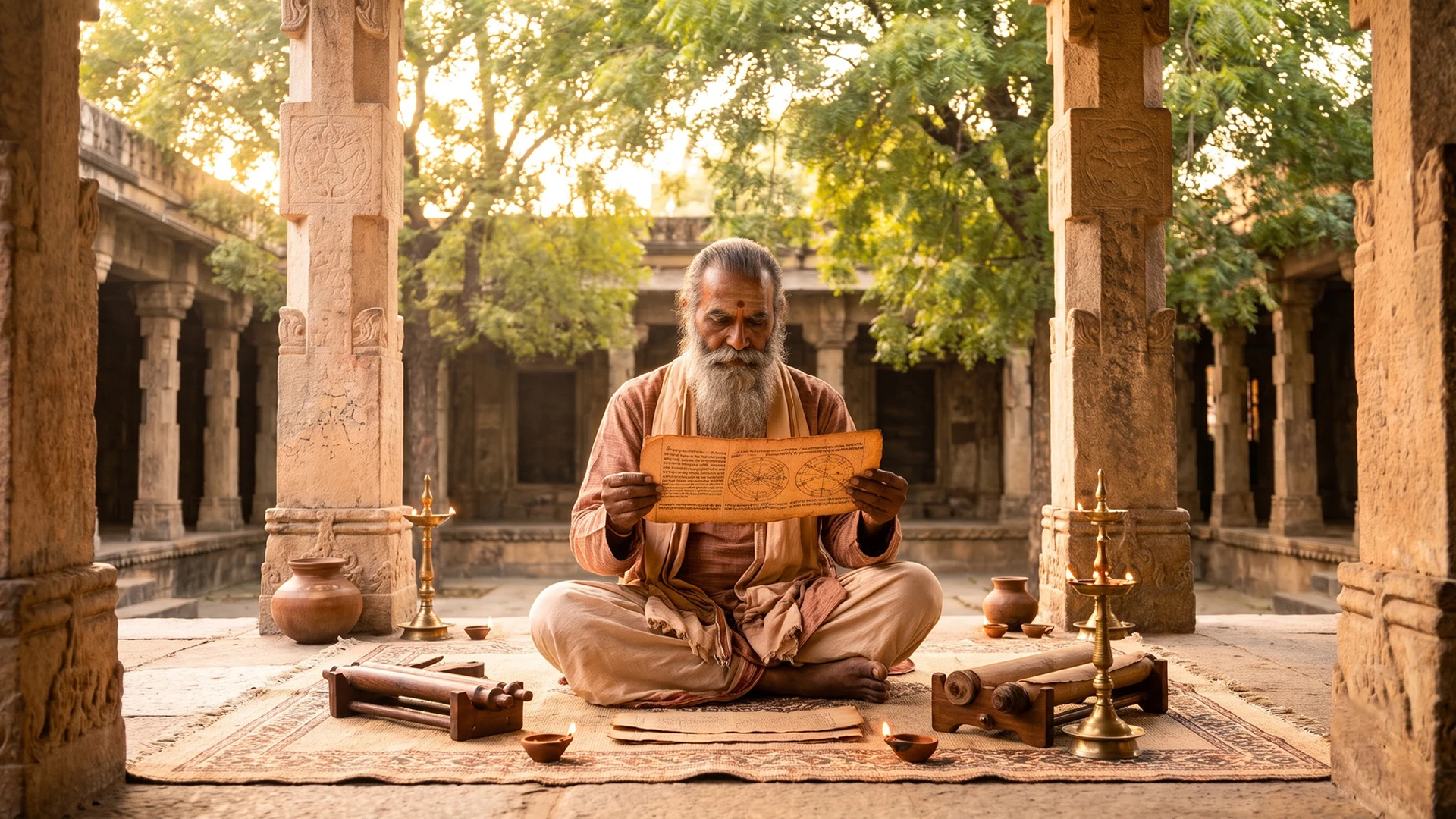
Unlike modern inventions that can be traced to a single laboratory, Vedic Astrology (Jyotish—the Science of Light) is a Vedanga, an inseparable limb of the ancient Vedas. In the Vedic tradition, no single mortal claims to be the "inventor" of this science; rather, it was cognized and systematized thousands of years ago—long before the dawn of European civilization—by India's enlightened Maharishis (Great Seers) who combined centuries of sky observation with deep yogic intuition (Divya Drishti).
1. Who Is the Janak (Father/Creator) of Astrology?
While the cosmic laws of time and the five elements (Panchamahabhutas—Earth, Water, Fire, Air, and Ether) originate from Lord Brahma at the dawn of creation, the credit for codifying astrology for humanity belongs to a sacred lineage of ancient Sages (Rishis), with Maharishi Parashara revered as the supreme Father (Janak) of Classical Horoscopic Astrology alongside Maharishi Bhrigu and Maharishi Jaimini:
Maharishi Parashara (The Father of Predictive Horoscopy): Author of the foundational masterpiece Brihat Parashara Hora Shastra, Sage Parashara systematized the core architecture of Vedic astrology—the 12 signs, 27 constellations, 16 divisional charts (Shodashvarga), planetary strengths, and the Vimshottari Dasha system—which remains the most widely practiced system of astrology in the world today.
Maharishi Bhrigu (The Father of Nadi & Karmic Time-Charts): Even earlier in the Vedic tradition, Sage Bhrigu (and the Nadi Sages) mapped the destiny patterns of human beings down to every 24-second interval of time, recording thousands of pre-written horoscopes on palm leaves (Bhrigu Samhita and Nadi Jyotish) and pioneering the intuitive planetary-link method where Jupiter represents the living soul (Jeeva) for men and Venus represents the living soul for women.
Maharishi Jaimini (The Master of Sign-Based & Upapada Astrology): A direct disciple of the Vedic lineage, Sage Jaimini authored the Jaimini Sutras, creating a brilliant hybrid of solar and lunar astrology using sign-based periods (Chara Dasha), variable significators (Chara Karakas), and the specialized Upapada Lagna to decode marriage and family lineage with surgical precision.
The Great Lineage of Seers & Savants (Vashistha, Valmiki & Varahamihira): Other towering sages—including Maharishi Vashistha, Maharishi Valmiki (who wove deep astrological and palmistry secrets directly into the Ramayana), and later astronomical savants like Varahamihira and Mantreswara—preserved and expanded the five classical branches of Siddhanta (Astronomical Mathematics), Samhita (Global/Mundane Forecasting), Hora (Natal Horoscopy), Shakun (Omens), and Prashna (Horary Time-Queries).
2. How Did Astrology Become So Popular Across the Ages?
For thousands of years, astrology was taught strictly through the sacred Guru-Shishya Parampara (Master-Disciple oral tradition) and preserved on palm-leaf manuscripts and annual almanacs (Panchangas). Why did millions of people—from emperors to village farmers—flock to astrologers across centuries?
The Universal Human Quest to Unravel Fate, Finance & Adversity: From the moment a newborn baby draws its first breath, cosmic rays and electromagnetic planetary vibrations act as the rotor of its destiny. Human beings have always sought to lift the veil of the unknown across ten core pillars of earthly life: Education, Character, Affluence (Finance), Social Status, Health, Career Ups and Downs, Matrimonial Felicity, Enjoyment, Spiritual Attainment, and Fame. Because astrology provided a tested, transparent compass to navigate financial prosperity and fight against oncoming life dangers, it became an everyday necessity across every stratum of society.
Survival Through Colonial Suppression & The Printing Press Revolution: During centuries of foreign rule, ancient Sanskrit libraries were systematically targeted and indigenous sciences were denigrated by colonial rulers. However, the arrival of the printing press in the late 19th and 20th centuries—much like the European Renaissance—allowed classical Sanskrit texts to be translated and printed into regional Indian languages and English, bringing astrological books into millions of homes.
The 20th-Century Institutional Revival: In the modern era, visionary scholars and researchers—led by pioneers such as Dr. B. Surya Narain Rao, Dr. B.V. Raman (who founded The Astrological Magazine in 1946 and the Indian Council of Astrological Sciences in 1985), Sri K.N. Rao (who established structured institutional teaching at Bharatiya Vidya Bhavan in New Delhi in 1987 and pioneered statistical double-transit research), and modern Nadi/KP researchers—stripped away the cobwebs of superstition, tested ancient aphorisms on thousands of real case studies, and won over the modern educated intelligentsia.
3. Why Is Astrology So Deeply Rooted in Indian Culture—Especially in Marriage?
In the West, people often view astrology as individual personality entertainment. In India, however, astrology is the bedrock of the family system—heard most visibly whenever a child is born (for naming and Janma Kundli casting), when a home is built (Muhurta and Vastu), and above all, when a marriage is arranged or finalized.
As documented across centuries of sociological and astrological observation, despite the saying that "marriages are made in heaven," the vast majority of families in India consult an astrologer to match the horoscopes of the bride and groom before marriage—and as a direct result, marriages in India have historically enjoyed remarkable stability and longevity.
Here are the five deep cultural and scientific reasons why astrology is inseparable from Indian marriage:
I. Marriage in India Is a Sacred Karmic Bond (Runanubandhana), Not Just a Social Contract
Indian civilization is rooted in the law of Karma, Rebirth (Punarjanma), and the Transmigration of the Soul. Marriage is not viewed as a temporary legal contract between two individuals, but as the coming together of two souls carrying past-life karmic debts (Purva-Punya and Prarabdha) and the union of two entire family lineages. Astrological matching checks whether the two horoscopes share harmonious karmic trajectories or destructive past-life friction.
II. Multi-Dimensional Psychological, Biological & Spiritual Compatibility (Kuta Matching)
Long before modern psychology or genetic counseling existed, the Hindu Maharishis recognized that the Moon governs the human mind, emotions, and biological fertility (converting solar life-energy into the birth of species). Traditional horoscope matching (Ashtakoota / 36-point and advanced 100-point scientific compatibility models) evaluates deep layers of human compatibility between bride and groom:
- Varna Kuta: Spiritual and ego development compatibility.
- Vasya Kuta: Mutual magnetic attraction and amenability.
- Grahamaitri (Rasyadhipathi): Psychological disposition, mental friendship, and natural affection between the two Moon sign lords.
- Yoni Kuta & Gana Kuta: Biological, temperamental, and sexual compatibility.
- Nadi Kuta: Physiological, genetic, and vitality harmony to ensure healthy progeny.
III. Deep Structural Inspection Beyond 36 Points (7th House, Navamsha & Upapada)
True Vedic marriage matching goes far beyond a mechanical 36-point Moon-star table from an almanac (Panchanga). Seasoned astrologers examine:
- The 7th House, 8th House (Mangalya / Longevity of Marriage) & 11th House: Checking the strength of the 7th house from both the Ascendant and the Moon, and ensuring there are no severe afflictions (such as uncancelled Mangal Dosha / Mars afflictions or 2nd/12th Dwidwadasa planetary clashes) that could cause early widowhood, separation, or chronic marital misery.
- The Navamsha (D-9) & Jaimini’s Upapada Lagna: Using the 9th harmonic divisional chart (Navamsha) and Sage Jaimini’s Upapada (calculated from the 12th house) to foresee the spouse’s character, family lineage, health, and whether the couple will enjoy lifelong conjugal devotion.
- The Jeeva-Karaka Harmony (Jupiter & Venus): Evaluating how Venus (the significator of the wife in a man's chart) and Jupiter (the significator of the husband in a woman's chart) interact across both charts.
IV. Intertwined Destiny & Financial Fortune (Bhagya) After Marriage
In Indian astrological tradition (as highlighted in classical texts like Jataka Parijata and Stree Jataka), the horoscopes of a husband and wife do not operate in isolation after their wedding day—their planetary periods (Dashas) and luck merge. A strong, well-matched spouse’s horoscope acts as a spiritual and material shield, bringing career elevation, wealth, healthy children, and protection during difficult planetary transits, whereas a severely mismatched chart can drain a family's peace and prosperity.
V. Pinpointing the Right Season to Marry (Timing of Marriage & Muhurta)
Finally, astrology protects families from wasted effort and heartbreak by identifying the exact age and planetary window when marriage is destined to fructify (through Dasha-Bhukti, Nadi transits, and the double transit of Jupiter and Saturn), and then selecting an auspicious Vivaha Muhurta (wedding moment) when the celestial configurations bless the couple with lifelong harmony, health, and abundance.